Magnesium Recovery Stir-Fry
Dark leafy greens, pumpkin seeds, and tofu loaded with magnesium — the mineral most depleted by chronic stress.
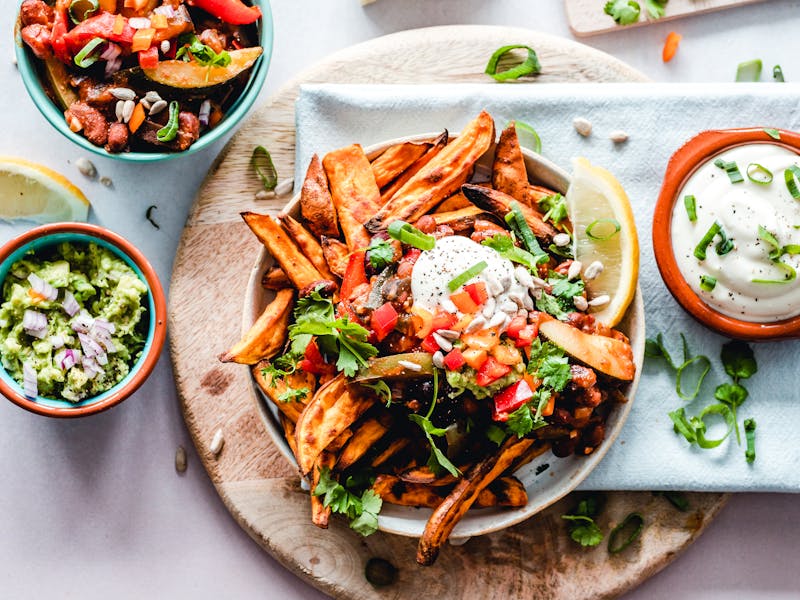
Why this works for founders
Cortisol — released during every stressful meeting, every crunch — depletes magnesium. Low magnesium wrecks sleep architecture: you spend less time in deep sleep, which is when memory consolidation and cellular repair happen. This dinner front-loads magnesium to compensate.
Ingredients (2 servings)
- 300g firm tofu, pressed and cubed
- 2 cups kale or Swiss chard, roughly chopped
- 1 cup frozen edamame, thawed
- 3 tbsp pumpkin seeds
- 2 cloves garlic, minced
- 1 tbsp ginger, grated
- 2 tbsp low-sodium soy sauce or tamari
- 1 tbsp sesame oil
- 1 tbsp olive oil
- 1 cup brown rice (cooked)
- Chilli flakes (optional)
Steps
- Press tofu: wrap in a towel, place something heavy on top for 10 min.
- Heat olive oil in a wok or large pan over high heat.
- Add tofu cubes. Cook 4–5 min per side until golden. Remove and set aside.
- Same pan: add sesame oil, garlic, ginger. Stir 30 seconds.
- Add kale. Stir-fry 2–3 min until wilted.
- Add edamame and tofu back. Pour over soy sauce. Toss 1 min.
- Serve over rice. Top with pumpkin seeds.
Magnesium sources in this bowl
- Pumpkin seeds: ~75mg per 3 tbsp
- Edamame: ~60mg per cup
- Kale: ~30mg per 2 cups
- Tofu: ~40mg per 300g
Macros per serving (approx)
- Calories: 510
- Protein: 32g
- Fat: 20g
- Carbs: 52g
Founder note
Eat this 3–4 hours before bed. Magnesium needs time to cross into the CNS.
The deeper logic on magnesium
Magnesium is a cofactor in over 300 enzymatic reactions, including
those involved in ATP stabilization, glutamate receptor regulation,
and the conversion of tryptophan to serotonin and then to melatonin.
The NHANES dietary data has consistently shown roughly half of US
adults consume less than the estimated average requirement (320 mg/d
for women, 420 mg/d for men). Stress is a known driver of magnesium
loss: catecholamines mobilize intracellular magnesium into plasma,
where some is excreted before it can be reabsorbed.
The clinical effect is subtle and additive rather than dramatic.
Magnesium-deficient adults report sleep latency that is roughly 15
minutes longer than replete adults and time-in-deep-sleep that is
roughly 10 to 15 minutes shorter, in continuous-monitoring studies.
Over a year, that adds up to roughly 50 to 80 hours of lost deep
sleep — most of which is the consolidation window for procedural and
declarative memory.
The form of magnesium matters less than the literature sometimes
implies for replete adults, but matters meaningfully for those
correcting a deficiency. Glycinate and citrate are well-absorbed;
oxide is roughly 4 percent bioavailable and is the form most
supplement aisles default to. Food sources skip the bioavailability
debate entirely; the magnesium in pumpkin seeds and dark leafy greens
is absorbed at roughly 30 percent fractional bioavailability.
Why this is a dinner, not a lunch
Magnesium needs time to reach plasma equilibrium. The peak after a
food source is roughly 4 to 6 hours; you want that peak landing in
the early stages of sleep, not during your 3 pm meeting. Eat this
between 6:30 and 7:30 pm and the magnesium arc supports the early
NREM cycles when most memory consolidation occurs.
The other dinner argument: tofu and edamame contribute roughly 30
mg/serving of magnesium each, plus the entire essential amino acid
profile. The protein arrival 4 hours before bed reduces overnight
hypoglycemia and the small adrenaline release that comes with it.
Substitutions
- No tofu: tempeh, halloumi, or pan-seared white fish all work.
Tempeh adds more fiber; halloumi adds more salt — adjust the soy
sauce. - No kale: Swiss chard, collard greens, spinach. Spinach cooks
in half the time, so add it at the end if you swap. - No edamame: frozen lima beans or peas. Both contribute
magnesium, not at edamame's density but enough. - Gluten-free: use tamari instead of soy sauce. Verify the bottle
— most tamari is gluten-free by default but a few brands aren't.
Storage detail
The stir-fry holds three days refrigerated. The texture is best at
day one (the tofu still has structure); by day three the tofu has
absorbed the sauce and softened. Some people prefer day three —
worth trying both.
Pumpkin seeds: store separately. They go soggy in the wet
refrigerated mix. Sprinkle at serving time.
Common mistakes
- Skipping the tofu press. Soft, wet tofu does not crisp; it
steams. Ten minutes under a plate stack drains the surface water
and lets the surface form a crust in the pan. - Adding the kale too early. It overcooks in a hot wok in 90
seconds. Add it last among the vegetables, then add the sauce
immediately after — the residual steam wilts the leaves without
destroying them. - Using low-quality soy sauce. The flavor backbone of this dish is
the soy; cheap soy reads salty and metallic. A bottle of Lee Kum
Kee or Yamasa premium is 6 dollars and lasts six months.
This is the founder dinner the night before a heavy decision day.
The magnesium tail does its work overnight; you wake up with a
slightly cleaner first hour. Run it three Sundays in a row before a
hard Monday and you will notice the pattern.