Sheet-Pan Chicken Thighs with Sweet Potato and Brussels
Bone-in thighs, sweet potato cubes, and shaved brussels on one tray — four dinners that hold all week.
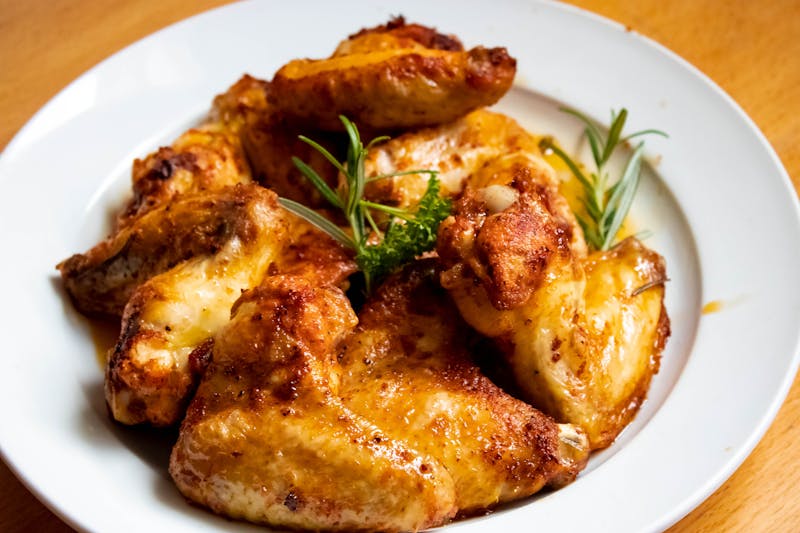
Why this works for founders
Bone-in chicken thighs have more iron and zinc than breasts, both of which sit upstream of every neurotransmitter your brain makes. Sweet potato gives you slow carbs and beta-carotene; brussels sprouts pack sulforaphane, which Stanford's Andrew Huberman has discussed as a Nrf2 pathway activator linked to cellular stress resistance. One sheet pan, four packed dinners.
Ingredients (4 servings)
- 8 bone-in, skin-on chicken thighs
- 2 medium sweet potatoes, cut into 2cm cubes
- 400g brussels sprouts, halved
- 3 tbsp olive oil
- 1 tbsp smoked paprika
- 1 tsp dried thyme
- 1 tsp garlic powder
- Salt and black pepper
- 1 lemon, halved
Steps
- Heat oven to 220°C / 425°F.
- On a large rimmed sheet pan, toss sweet potato and brussels with 2 tbsp olive oil, salt, pepper.
- Push veg to the edges. Place thighs skin-up in the centre.
- Rub thighs with remaining oil, paprika, thyme, garlic powder, salt.
- Roast 35–40 min, until thigh internal temp hits 75°C / 165°F and skin is crisp.
- Squeeze lemon over the pan. Rest 5 min.
- Divide across four containers. Holds 4 days refrigerated.
Macros per serving (approx)
- Calories: 580
- Protein: 42g
- Fat: 28g
- Carbs: 38g
Founder note
If you have a cast iron pan instead of a sheet pan, sear the thighs skin-down for 3 minutes before transferring everything to the oven. The skin crisps better.
The deeper logic
Bone-in chicken thighs have roughly 30 percent more iron per gram
than chicken breast and a comparable advantage in zinc. Both minerals
sit in the upstream chemistry of neurotransmitter synthesis: iron is
a cofactor for tyrosine hydroxylase (dopamine synthesis), zinc is a
cofactor for over 200 enzymes including those involved in GABA and
glutamate balance. Iron-deficient adults — disproportionately women
of reproductive age and vegetarians — show measurable cognitive
performance reductions on attention and processing-speed tasks that
resolve with repletion.
Sulforaphane, the isothiocyanate produced when brussels sprouts are
chopped or chewed, is one of the more potent natural Nrf2 pathway
activators. Nrf2 regulates the transcription of cellular antioxidant
defenses. Andrew Huberman's lab at Stanford has discussed
sulforaphane in the context of cellular stress resistance; the
underlying biochemistry has been characterized extensively at Johns
Hopkins by the late Paul Talalay.
Sweet potato carries roughly 2.5 mg of beta-carotene per 100 g —
enough that a single 200 g serving delivers more than the daily
preformed-vitamin-A equivalent. Beta-carotene conversion to retinol
varies between individuals (BCMO1 genotype is the main variable) but
in healthy adults the conversion supports normal vitamin A status
from the sweet potato alone.
Why this is the founder go-to sheet-pan dinner
The dish is engineered around three constraints: one pan, 40 minutes
total elapsed, four servings. The pan is cleaned with the same step
that takes the food out (deglaze with a splash of stock to lift the
fond, pour into a jar, refrigerate as a base for next week's risotto
or grain bowl). The 40 minutes covers a 35-minute roast plus 5
minutes of active prep. Four servings holds Sunday's dinner plus
three lunches; you can scale to eight if you start with two sheet
pans on staggered racks.
Cook this Sunday night and the week's hard problem — what to eat at
1 pm when meetings have run over — is solved through Wednesday.
Substitutions
- No bone-in thighs: boneless thighs work but reduce roast time
to 25 minutes. Bone-in breasts work too — adjust to 35 to 40
minutes for breast-on-the-bone, internal 75 C. - No sweet potato: butternut squash cubes, parsnip, or rutabaga.
All roast in the same window. Avoid white potato — the glycemic
profile is significantly higher. - No brussels sprouts: broccoli florets, cauliflower, or kale
ribs. Kale ribs are an underused option — they crisp like brussels
sprout leaves but cook in less time, so add them in the last 15
minutes.
Storage detail
Refrigerated portions hold 4 days. Reheat at 70% power in 90-second
bursts; finish with a fresh squeeze of lemon to revive the flavor.
The skin softens through the refrigeration; if you want the crisp
back, run the portion under the broiler for 90 seconds, watching
closely.
Common mistakes
- Crowding the pan. The sheet pan needs space for steam to escape;
food packed wall-to-wall braises instead of roasts and the brussels
sprouts arrive soggy. Use two pans if you scale up. - Putting the thighs skin-down. The skin needs to dehydrate in the
oven air, not steam against the pan. Skin up, every time. - Skipping the lemon at the end. The acid lifts the rich, fatty
thigh meat. Without it the dish reads heavy.
The bone-in thigh is the most underrated cut in the founder kitchen.
Cheap, forgiving, technique-tolerant, nutritionally dense. Buy a
pack of eight; cook them Sunday. You are set.