Sunday Salmon Batch — 5 Lunches in 40 Minutes
Omega-3-rich salmon portions, roasted veg, and brown rice prepped once so your week stays execution-mode.
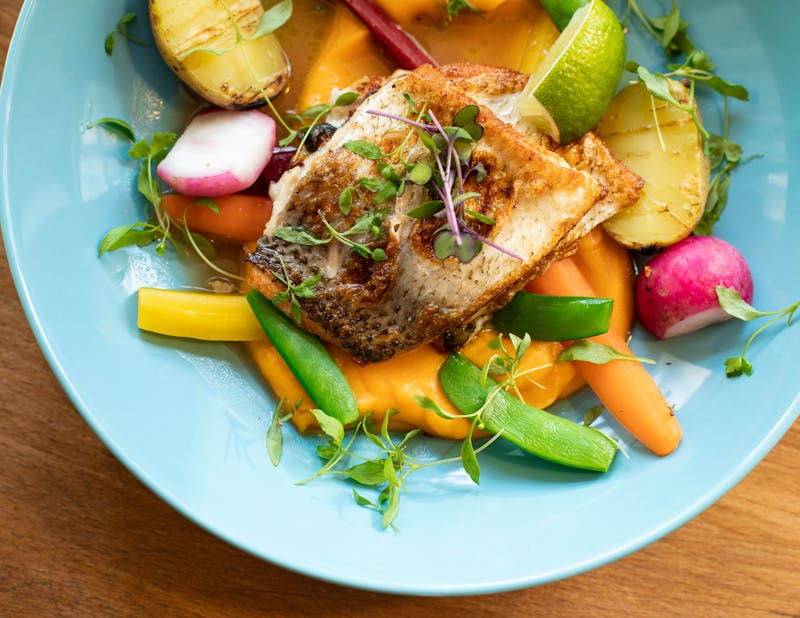
Why this works for founders
Your brain is 60% fat. DHA — the omega-3 found in salmon — is the structural fat in your neurons' myelin sheaths. Low DHA correlates with slower processing speed and worse working memory. This batch gives you five high-DHA lunches with zero decision cost on the days that matter.
Ingredients (5 servings)
- 5 salmon fillets (150g each), skin on
- 2 cups brown rice (dry)
- 500g broccoli florets
- 300g cherry tomatoes
- 3 tbsp olive oil
- 2 lemons
- Salt, pepper, garlic powder
- Fresh dill or parsley (optional)
Steps
Rice (start first, it takes longest):
1. Rinse rice. Combine with 4 cups water + pinch of salt in a saucepan.
2. Bring to boil, reduce to low, cover, cook 35 minutes. Remove from heat, rest 5 min.
Salmon + veg (while rice cooks):
1. Preheat oven to 200°C / 400°F.
2. Line two baking sheets. Toss broccoli and tomatoes with 2 tbsp oil, salt, pepper. Spread on one sheet.
3. Place salmon skin-down on second sheet. Drizzle with remaining oil, season, add lemon slices.
4. Roast both sheets 20 minutes. Salmon is done when it flakes with a fork. Veg should have some char.
Pack:
1. Divide rice across 5 containers (roughly ½ cup cooked per serving).
2. Add one salmon fillet and a portion of veg to each.
3. Squeeze lemon over each. Seal. Refrigerate up to 4 days.
Macros per serving (approx)
- Calories: 520
- Protein: 42g
- Fat: 18g (6g omega-3)
- Carbs: 45g
Founder note
Prep Sunday 5–6pm. Eat Monday–Friday. The constraint is the container stack in your fridge, not willpower at noon when you're mid-deep-work.
The deeper nutritional logic
Salmon's value is two compounds at once. The first is DHA, a 22-carbon
omega-3 that integrates structurally into cell membranes throughout the
nervous system. The Framingham Offspring Study cohort showed an
inverse relationship between erythrocyte DHA levels and the rate of
hippocampal volume loss over a decade of follow-up — a finding
replicated in several longitudinal studies including the AGES-Reykjavik
data. The second is astaxanthin, the carotenoid that gives the flesh
its pink color. Astaxanthin crosses the blood-brain barrier and shows
up in plasma after a single salmon meal; whether the downstream effect
on neuronal oxidative stress is large or small in healthy adults is
still debated, but the molecule is there.
Wild salmon carries more astaxanthin than farmed because it eats
krill; farmed salmon is supplemented with synthetic astaxanthin to
achieve the color consumers expect. The DHA content of farmed Atlantic
salmon is comparable to wild, sometimes higher per gram, because of
the formulated feed. The wild-versus-farmed question is more about
contaminants, sea lice management, and the broader environmental
ledger than the per-fillet nutrition.
Why the batch format is the point
A founder's worst nutritional decisions are the lunches they make at
noon when they have not pre-decided. The batch is not about the
salmon. It is about removing five lunch decisions from a week, so the
attention you would have spent on "what should I order" goes to work
that actually matters.
The literature on decision fatigue is mixed — the original Baumeister
ego-depletion findings have not replicated cleanly — but the
operational case is independent of the mechanism. Pre-decided lunches
that take 90 seconds to plate are objectively faster than ordered
lunches, eat less calendar, and run roughly $4 per serving versus $14
to $18 for a delivered equivalent.
Substitutions
- No salmon: swap arctic char, steelhead, or mackerel. Arctic char
is the closest in fat profile and price. Mackerel has more omega-3
per gram but a stronger flavor; not everyone wants mackerel five
days running. - No brown rice: farro, barley, quinoa, or wild rice. Each pushes
the meal slightly different — quinoa adds protein, farro adds chew,
wild rice adds nuttiness. Avoid white rice; the glucose curve in the
afternoon is the whole point. - No broccoli: any roastable cruciferous works. Cauliflower,
brussels sprouts halved, romanesco. The sulforaphane content varies
but the macronutrient profile is close.
Storage detail
Cooked salmon holds 4 days refrigerated at 4 degrees C, or 3 months
frozen if you portion individually and vacuum-seal. The texture suffers
slightly on day 4 — the flesh dries — which is why the lemon goes in
each container at packing time. The acid keeps the surface from going
chalky.
Reheat at 60% power in 90-second bursts, or eat cold over salad. The
microwave-and-walk-back-to-the-call reheat is the realistic case;
don't bother with the oven for a single portion mid-week.
Common mistakes on the first cook
- Roasting the salmon to 75 C internal. The fish overcooks by then.
Pull at 52 to 54 C internal — the carryover takes it to a perfect
flaky 56 C while it rests. - Skipping the lemon. The acid is doing flavor work but also keeps
the flesh from oxidizing during the 4-day refrigerator life. - Putting the rice at the bottom of the container under hot salmon
before it has cooled. Steam softens the grain and the texture
collapses by day 2. Cool the rice. Layer with cold salmon. Seal.
The single Sunday hour buys you the entire week's noon-to-1pm
intervention. Read that as compounding capital, not as cooking.