The Potato Trail — From the Andes to the Irish Famine
The potato was domesticated in the Peruvian Andes 8,000 years ago. By 1800 it was the calorie staple of northern Europe. By 1850 it had killed a million Irish.
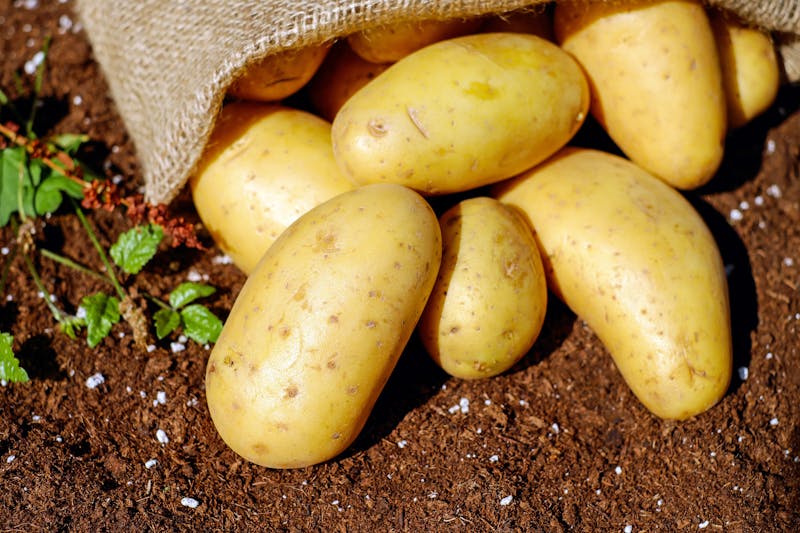
The origin
The potato (Solanum tuberosum) was domesticated near Lake Titicaca, in present-day Peru and Bolivia, around 8,000 years ago. Andean farmers selected for high-altitude tolerance and developed somewhere between 3,000 and 4,000 distinct varieties — purple, yellow, red, frost-tolerant, drought-tolerant.
Spanish conquistadors brought the potato to Europe in the late 16th century. It was treated with suspicion for two centuries — wrong family (nightshades), wrong shape, wrong origin. It became Europe's calorie staple in fits and starts, fully accepted by 1750.
Why the potato spread so fast
Calorie yield per acre. A potato field produces roughly four times the calories of a wheat field of the same size, in less labor, on poorer soil. For 18th- and 19th-century European peasants, this was transformative. Population doubled or tripled in regions that adopted the potato as a staple.
The Irish famine
By the early 1800s, the Irish peasantry was almost entirely dependent on a single potato variety — the Lumper. When Phytophthora infestans — a potato blight — arrived in 1845, the lack of varietal diversity meant the entire crop failed across consecutive years. Roughly one million Irish died of starvation and disease between 1845 and 1852. Another two million emigrated.
The famine was not just a biological event. British colonial policy continued exporting Irish wheat and livestock to England throughout the famine years. The crop failure was natural; the death toll was political.
The lesson
A food system that runs on a single variety of a single crop is fragile. Monoculture is biologically and politically fragile. The 19th-century Irish version is the historical model for 21st-century concerns about, say, the Cavendish banana, or the Gros Michel before it, or industrial wheat varieties facing UG99 rust.
The Andean varieties
The Peruvian International Potato Center (CIP) maintains a seed bank of around 5,000 potato varieties. Indigenous Andean farmers continue to grow several thousand of these in small-scale cultivation. The genetic library is the reserve against future blights.
What to do in the kitchen
- Try a true heirloom variety when you find one. Farmers markets in the US increasingly stock fingerlings, purple Peruvians, Russian banana fingerlings.
- Floury vs waxy is the practical distinction. Floury (russets, Yukon Golds): roasting, mashing, baking. Waxy (red, fingerling, new potatoes): boiling, salad, gratin.
- Don't store potatoes in the fridge — the cold converts starch to sugar.
Related reading
- Larry Zuckerman, The Potato (1998) — the history.
- Charles Mann, 1493 — chapter on the potato's spread.
- Cormac Ó Gráda, Black '47 and Beyond (1999) — the famine, in depth.
The Andean origin
The potato (Solanum tuberosum) was domesticated in the Andes
roughly 8,000 years ago. The cultural cradle was the Lake Titicaca
region, between present-day Peru and Bolivia. Indigenous Andean
cultures developed thousands of potato varieties adapted to
specific altitudes, soils, and climates.
The contemporary potato monoculture — a handful of high-yield
varieties grown industrially — is a tiny fraction of the diversity
that existed in the Andes pre-Columbus and that survives today in
the high-altitude Quechua and Aymara farming communities.
The Columbian Exchange and Europe
Spanish colonizers brought potatoes to Europe in the late 16th
century. Adoption was slow; the potato was suspected of toxicity
(the leaves contain solanine) and was used as livestock feed and
emergency food before becoming a staple.
By 1700 the potato was established in Spain, Italy, and Portugal.
By 1800 it had reached northern Europe; by 1850 it was the staple
food of Ireland, Poland, and parts of Germany.
The Irish Famine
The Irish dependence on the potato by the 1840s was nearly total:
roughly half the Irish population ate potatoes as the primary
caloric source. The dependence was driven by British colonial land
policy, which had forced Irish tenants onto small plots where the
potato was the only crop that could produce enough calories per
acre to support a family.
When Phytophthora infestans — the late blight pathogen — arrived
in Ireland in 1845, the resulting crop failures killed roughly one
million people and drove another million to emigrate. The Famine
was triggered by the pathogen; it was caused by the colonial
political economy that had made potato monoculture unavoidable.
The Famine remains one of the clearest examples in modern history
of what happens when food sovereignty is removed.
The contemporary Andean revival
Indigenous Andean farmers continue to maintain hundreds of potato
varieties. The International Potato Center (CIP) in Lima
catalogues them; the Quechua community-based Parque de la Papa
near Cusco maintains a living archive of over 1,400 varieties.
The contrast with the contemporary industrial-potato monoculture
(Russet Burbank dominates much of the US French-fry industry) is
the food-diversity argument in its cleanest form.
What to cook
If you can source Andean varieties — through specialty
purveyors or farmers markets — cook them. The flavor differences
between varieties are significant. The yellow Yukon Gold and the
red Pontiac are common; the purple Peruvian and the fingerling
French varieties less so but worth seeking.
For French fries, Russet Burbank works fine but is not the only
option. The Bintje variety (Dutch heirloom) makes a remarkably
better fry.
Further reading
- Charles Mann, 1493 (2011) — extensive potato discussion.
- Christine Padoch, Eating in the City (2012).
- Dan Saladino, Eating to Extinction (2021).
- John Reader, Potato: A History of the Propitious Esculent
(2008).