The Wheat Trail — From Fertile Crescent to White Sandwich Bread
Wheat was domesticated 10,000 years ago in the Fertile Crescent. The journey from einkorn to industrial roller-milled white flour is a fast and lossy one.
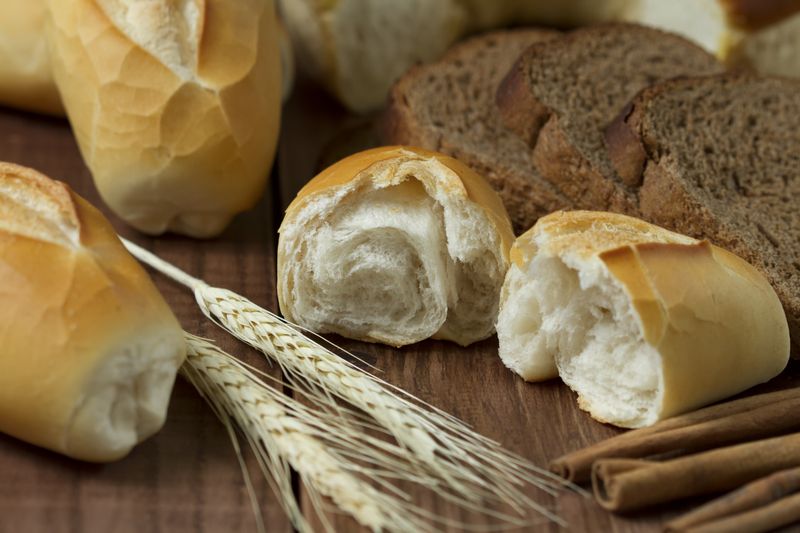
The origin
Wheat was domesticated in southeastern Turkey and the Levant around 10,000 BCE — among the first crops, alongside barley, peas, lentils, and chickpeas. The wild ancestor is Triticum monococcum (einkorn), still grown in small quantities in parts of Turkey and Italy.
Across the next 8,000 years, wheat spread into Europe, North Africa, the Indian subcontinent, and East Asia. Each region selected for local conditions and developed local processing — flatbreads in West Asia, leavened breads in Egypt and Mesopotamia, noodles in China, semolina pasta in the Mediterranean.
The mill
Until the late 19th century, wheat was milled between stones — a heavy abrasive process that left bran and germ in the flour. Stone-ground whole wheat was the default for most of human history; pure white flour was a luxury good.
The roller mill, perfected in the 1870s in Hungary and Minnesota, changed this. Roller mills strip the bran and germ cleanly, producing a fine white flour at low cost. By 1900, white flour was cheap enough to be the working-class default in Europe and North America. By 1930, the bran and germ — which together contain nearly all of wheat's fiber, B vitamins, minerals, and beneficial fats — were industrial byproducts, mostly fed to livestock.
The nutritional consequence
Refined white flour is essentially pure starch. It spikes blood glucose nearly as fast as table sugar. The "enriched flour" laws of the 1940s — which mandated adding back thiamine, niacin, riboflavin, iron, and later folate — were a public health response to a deficiency epidemic created by the roller mill.
Whole wheat retains 10-12g of fiber per 100g. Refined white retains 2-3g.
The varieties
Modern industrial wheat is dominated by a handful of high-yielding semi-dwarf varieties bred in the Green Revolution (Norman Borlaug's work in the 1960s). Heirloom varieties — Red Fife, Turkey Red, einkorn, emmer, spelt, Khorasan — exist now mostly in small artisan production.
What to do
If you eat bread regularly:
- Find a real bakery. Whole-grain or part-whole-grain sourdough. The fermentation matters: long-fermented dough produces lower glucose response than fast-yeast dough.
- Buy a stone-ground whole wheat flour if you bake.
- Seek out heirloom-variety flour (Anson Mills in the US, Hayden Flour Mills, Cairnspring Mills, Camas Country Mill — multiple small US mills now make this accessible).
- Read Maria Speck, Ancient Grains for Modern Meals (2011). Useful kitchen-side companion.
Related reading
- Dan Saladino, Eating to Extinction — chapter on heritage grains.
- Modernist Bread (Nathan Myhrvold et al.) — encyclopedic, expensive, comprehensive.
Origin
Wheat (Triticum) was first domesticated roughly 10,000 years ago
in the Fertile Crescent — a region covering parts of contemporary
Iraq, Syria, Lebanon, Israel, Jordan, and southeastern Turkey. The
original cultivars were einkorn (Triticum monococcum) and emmer
(Triticum dicoccum); modern bread wheat (Triticum aestivum) is a
later hexaploid hybrid that emerged through natural hybridization
roughly 8,000 years ago.
The crop spread out from the Fertile Crescent along trade routes:
into Europe by 5000 BCE; into North Africa around the same time;
into India and East Asia by 3000 BCE. By the Roman period, wheat
was a staple grain across the Mediterranean and Western Europe.
The 20th-century industrialization
The mid-20th century Green Revolution, led by Norman Borlaug's
work at CIMMYT in Mexico, produced dwarf wheat varieties that more
than doubled global wheat yields. The same revolution narrowed the
diversity of cultivars in cultivation. A handful of modern wheat
varieties now account for the vast majority of global wheat
production.
In parallel, the Chorleywood Process (UK, 1961) industrialized
bread production by drastically shortening fermentation time. The
process produces uniform white sandwich bread at industrial scale.
The trade-off: the long fermentation that breaks down starches
and develops flavor compounds is largely absent in industrial
bread.
The nutritional consequence
A loaf of industrial white bread is closer to refined sugar in
glycemic profile than to traditional bread. The fiber has been
removed; the fermentation has been shortened; the protein
structure has been mechanically agitated to compress hours of
fermentation into minutes.
Traditional sourdough bread — long fermentation, whole grain,
slow rise — carries a glycemic index roughly 20 to 30 percent
lower than industrial white bread of equal weight. The fiber
content is significantly higher. The micronutrient density is
higher.
The revival
The 2010s and 2020s have seen a substantial revival of traditional
bread baking in the West. The Tartine school (Chad Robertson, San
Francisco), the heritage-grain revival (Anson Mills and others),
and the proliferation of home sourdough during the 2020 pandemic
have rebuilt some of the diversity that the industrial revolution
removed.
What to do
Source bread from a real bakery that uses long fermentation. Or
bake your own — a basic sourdough takes one weekend to learn and
produces a meaningfully better loaf than supermarket bread.
For heritage flours, Anson Mills and a small number of mills in
the UK, France, and Italy sell heirloom wheat varieties (Red Fife,
Turkey Red, einkorn, emmer). The flavor difference is significant.
Further reading
- Catherine Zabinski, Amber Waves: The Extraordinary Biography
of Wheat (2020). - Aaron Bobrow-Strain, White Bread (2012).
- Dan Saladino, Eating to Extinction (2021) — wheat chapters.
- Chad Robertson, Tartine Bread (2010).