Why Supermarket Bread Tastes Wrong — The Chorleywood Process
Most industrial bread is made in under three hours using a process invented in 1961. Real bread takes 12-72. The difference is structural, not aesthetic.
The technology
In 1961, the British Baking Industries Research Association in Chorleywood developed a process to make bread faster and from lower-protein domestic wheat. The Chorleywood Bread Process (CBP) uses high-speed mechanical mixing (much more intense than hand or traditional mechanical kneading), chemical additives (oxidizing agents, emulsifiers, enzymes), additional fat, more yeast, and ascorbic acid (vitamin C) as a dough conditioner.
Total time from flour to loaf: about three and a half hours. Traditional bulk-fermented bread: 12-24 hours. Sourdough: 24-72.
The CBP became the dominant industrial bread method in the UK, Australia, New Zealand, and much of the Commonwealth. The US industrial baking system uses related fast-process methods.
By the 1990s, roughly 80% of UK bread was made via Chorleywood or a close variant. Today the figure is still over 70%.
What the process produces
- Visual. A loaf with uniform texture, an even crumb, a soft crust.
- Flavor. Limited. Long fermentation produces the sour, complex flavors of real bread. Three-hour bread doesn't have time to develop them.
- Shelf life. Several days at room temperature without staling — a commercial requirement, not a quality benefit.
- Nutritional content. Lower fiber than slow-fermented whole-grain bread. The fast fermentation also doesn't break down the FODMAP carbohydrates (oligosaccharides) that some people find hard to digest. There's reasonable evidence that some "gluten sensitivity" is actually a reaction to fast-fermented bread rather than to gluten itself.
Why slow-fermented bread is different
A long bulk fermentation (12+ hours) does several things that CBP doesn't:
- Lactic and acetic acid production. Lactobacillus species develop alongside the yeast, producing acids that contribute to flavor and lower the bread's glycemic response.
- Enzymatic breakdown. Time allows enzymes naturally present in the flour to break down starch and protein, producing more flavor compounds and predigesting some of what's hard for humans to process.
- Gluten structure. Long fermentation develops gluten organically through hydration and fold, rather than through high-intensity mechanical shearing. The result is a more open, irregular crumb.
- Glycemic index. A long-fermented sourdough produces a smaller blood glucose response than a fast-fermented industrial bread of equivalent flour.
How to spot real bread
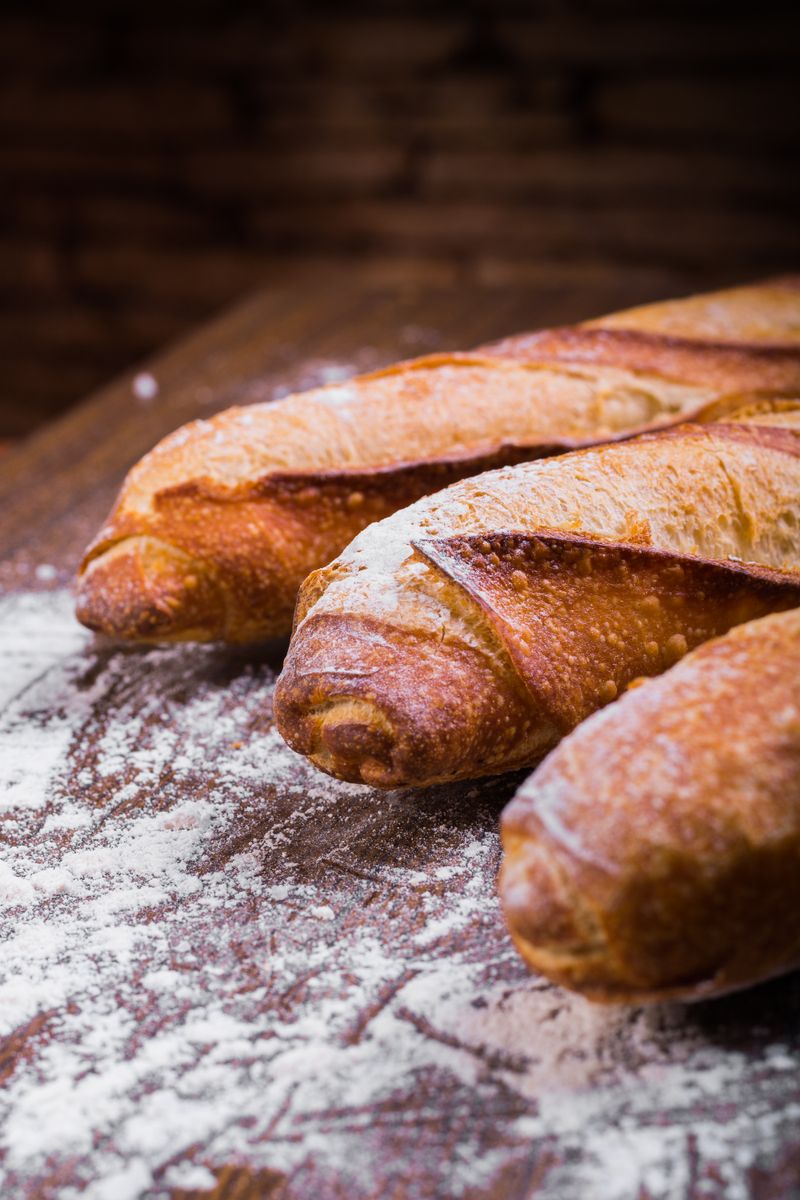
- Crust. Real bread has a thick, audibly crackling crust. Industrial bread has a soft, uniform crust.
- Crumb. Real bread has an irregular crumb, with holes of varied size. Industrial bread is uniform.
- Aroma. Real bread smells lactic, slightly sour, complex. Industrial bread smells faintly yeasty and faintly sweet.
- Weight. A 500g loaf of real bread feels heavy for its size. Industrial bread feels light.
- Staling. Real bread is at peak day 1, still good day 2, declining day 3. Industrial bread stays the same for a week — because the additives suppress staling, not because the bread is fresh.
What to do
- Find a real bakery in your area that bulk-ferments for 12+ hours. Most cities of any size now have at least one. Buy from them.
- If no local bakery: bake your own. Tartine's Bread (Chad Robertson, 2010), the Modernist Bread series, or Ken Forkish's Flour Water Salt Yeast (2012) are the home-bakery references.
- Avoid bread products with more than five or six ingredients. Real bread is flour, water, salt, leavening. Everything past that is industrial.
Reading
- Andrew Whitley, Bread Matters (2006). Direct on the Chorleywood issue.
- Chad Robertson, Tartine Bread (2010). The home-bakery reference.
- The Bread Builders (Daniel Wing and Alan Scott, 1999). Older, technical, comprehensive.
The 1961 process
The Chorleywood Bread Process was developed at the Flour Milling
and Baking Research Association in Chorleywood, England, in
1961. The process compressed traditional bread fermentation
(which took 6 to 24 hours) into approximately 90 minutes through
several modifications:
- High-speed mechanical mixing. Doughs were beaten at high
intensity for 3 minutes, which substituted for the gluten
development that long fermentation produces. - Higher water content. Allowed by the mechanical mixing.
- Added fats. To compensate for the texture changes from
the abbreviated fermentation. - Added emulsifiers. To support dough handling.
- Added enzymes and ascorbic acid. To accelerate the
biochemical processes. - Higher levels of yeast. To compensate for the shorter
rise time.
The result was a uniform, white, sandwich-style bread that
could be produced industrially in roughly 3 hours from flour
to finished loaf, compared to 8 to 24 hours for traditional
methods.
What was lost
The flavor compounds that develop in long fermentation —
organic acids, esters, alcohols, and the breakdown products of
proteins and starches — are largely absent in Chorleywood
bread. The flavor profile reads flat, slightly sweet (from
the added sugar and from the unfermented sugars in the flour),
and one-dimensional.
The glycemic response also differs. Long-fermented bread has a
measurably lower glycemic index than Chorleywood bread of equal
ingredients, because the fermentation breaks down some of the
starches.
The protein structure is different too. The mechanical
agitation produces a different gluten network than slow
fermentation; for some sensitive individuals, the Chorleywood-
style bread produces more digestive complaints than traditional
sourdough does, even though the wheat itself is identical.
The current scale
By 2020, the Chorleywood Process produced approximately 80
percent of UK supermarket bread. The US sliced-bread industry
uses related processes (the Continuous Mix Process developed
independently in the US in the 1950s) with similar effects.
Most supermarket bread in the developed world is some form of
the rapid-industrial-fermentation tradition. The traditional
long-fermentation tradition survives in specialty bakeries
and home baking.
The traditional alternative
A real sourdough loaf takes 18 to 36 hours from start to
finish, most of that unattended time. The active work is
approximately 30 minutes spread across 2 days. The result is
a bread that is meaningfully different — denser, more complex
in flavor, with a glycemic profile closer to whole-wheat
porridge than to refined white bread.
The Tartine method (Chad Robertson's Tartine Bread, 2010) is
the contemporary reference. Maurizio Leo's The Perfect Loaf
(2022) is the more recent comprehensive home-baking guide.
What to do
If you bake at home, the sourdough switch pays for itself in
months — the long-fermented bread is better, cheaper, and more
satisfying than supermarket bread.
If you buy bread, find a real bakery that uses traditional
fermentation. The price difference (typically 4 to 8 dollars
versus 3 dollars for industrial bread) reflects the labor and
time difference; the flavor difference is significant.
Further reading
- Andrew Whitley, Bread Matters (2006).
- Aaron Bobrow-Strain, White Bread (2012).
- Chad Robertson, Tartine Bread (2010).
- Maurizio Leo, The Perfect Loaf (2022).